RoomTokens:
Masked Diffusion over Structured Tokens
for Indoor Scene Synthesis

1Simon Fraser University 2Alberta Machine Intelligence Institute (Amii)
Given input architecture, MDiRT generates furnished rooms using RoomTokens. This video shows the denoising process, with expanded vertical slice spacing for clarity.
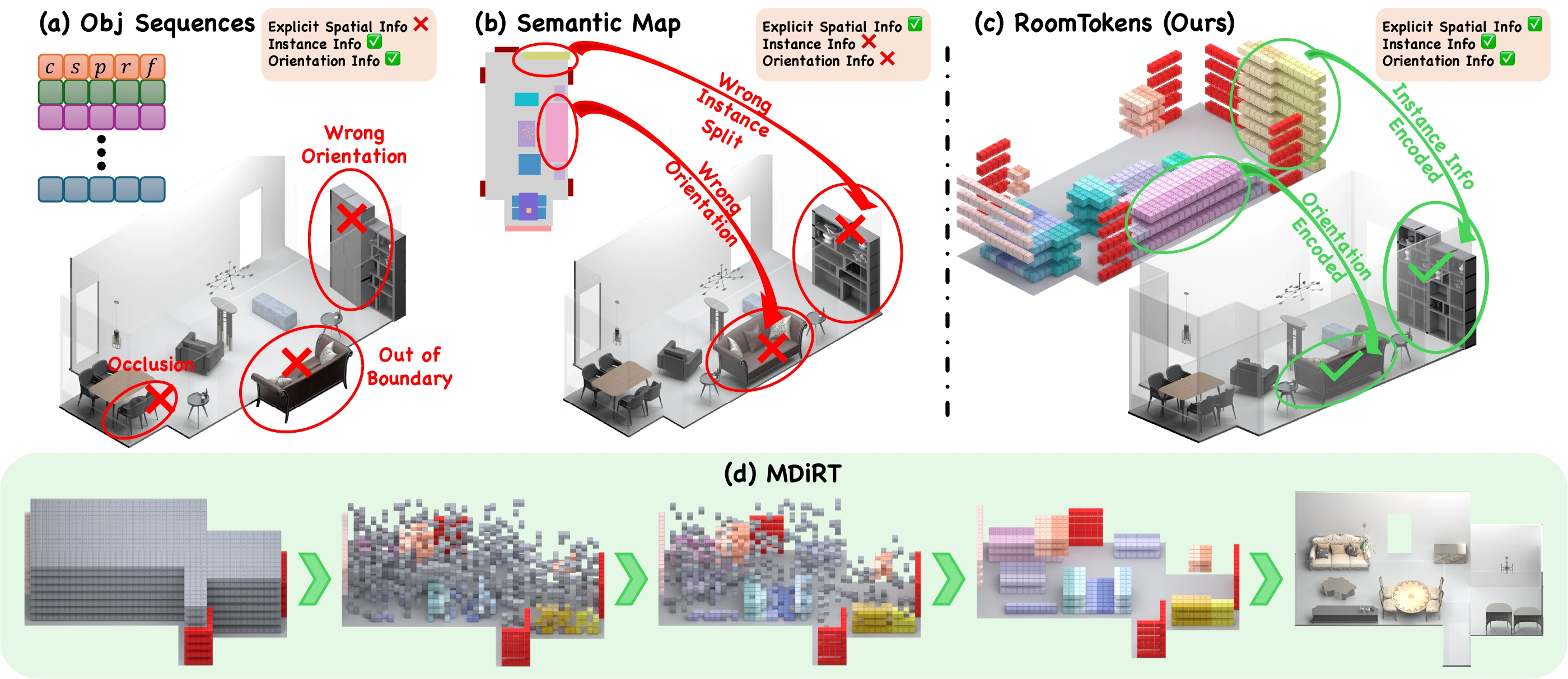
RoomTokens combines semantic class, instance identity, and facing information across horizontal slices, then uses masked diffusion to synthesize furnished rooms.

We generate furnished 3D rooms that respect architectural constraints. Existing object sequences lack explicit spatial relationships, while semantic maps omit height, instance identity, and orientation. We introduce RoomTokens, a sliced spatial representation that captures these cues, and MDiRT, a masked diffusion model that generates RoomTokens while keeping architecture fixed. On 3D-FRONT, our approach improves layout fidelity and physical consistency over prior methods.

Data Representation

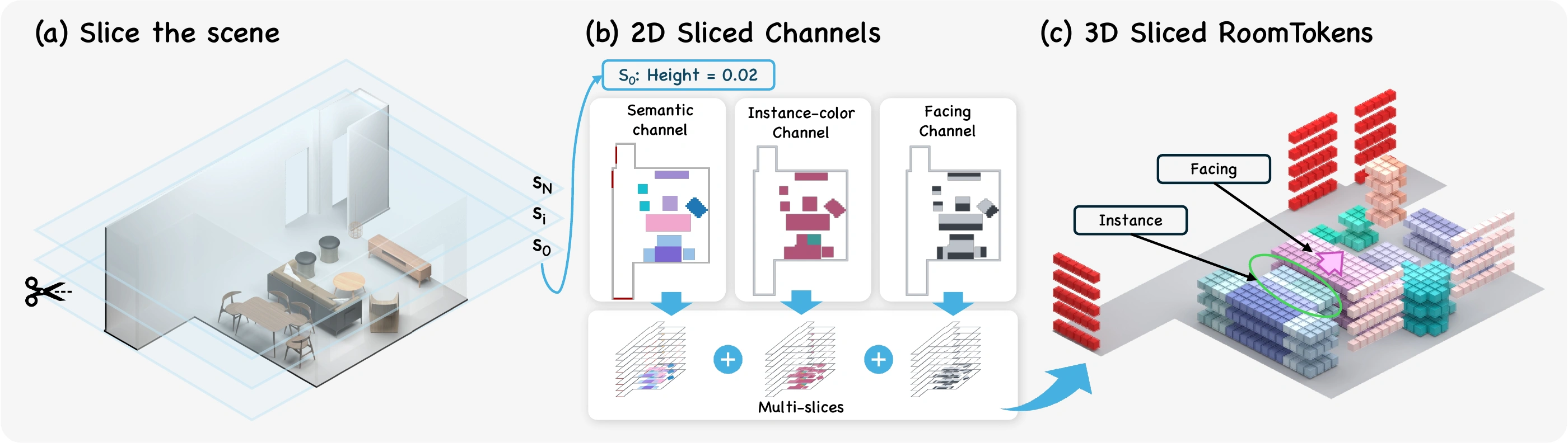
RoomTokens represents a 3D room as stacked horizontal slices. Each cell stores a semantic class, an instance-color label to distinguish neighboring objects, and a facing cue to recover orientation. Together, the slices preserve spatial layout, object identity, and height structure in a discrete grid.
A room is sliced at selected heights into aligned semantic, instance-color, and facing channels.

Method Overview

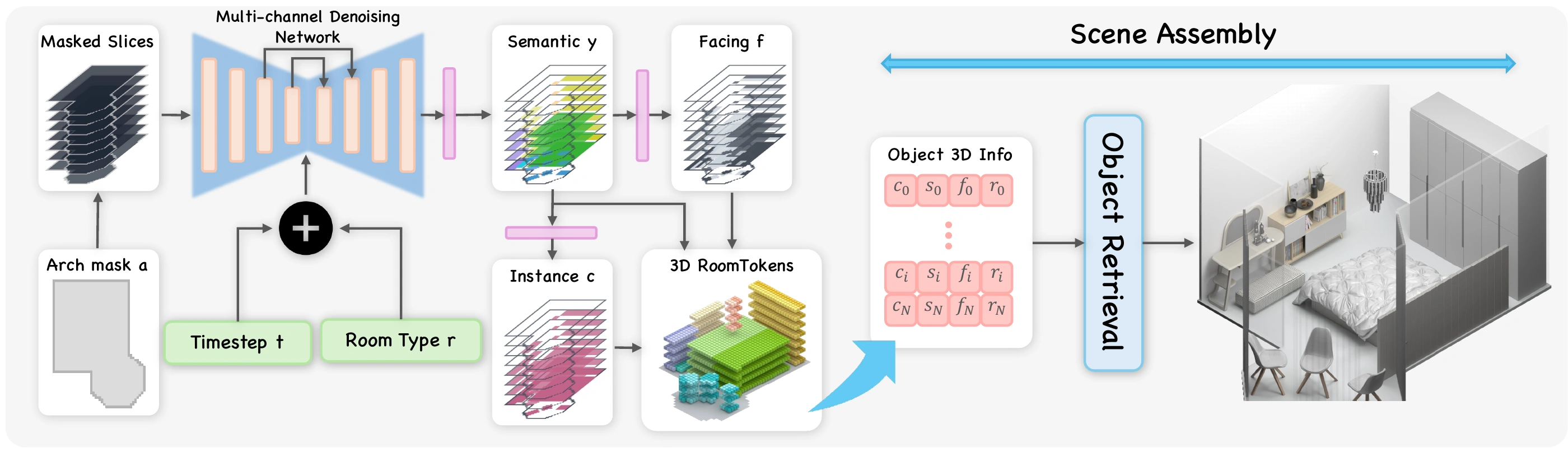
Given input architecture, MDiRT progressively denoises masked RoomTokens while keeping architectural tokens fixed. Cross-slice attention shares information across heights to generate consistent object structure. We then group tokens into objects, recover their category, size, and pose, and retrieve and place matching 3D assets to form a furnished room.
MDiRT takes masked slices and an architectural mask, predicts semantic, instance-color, and facing slices, then groups the tokens into objects and retrieves matching furniture.

Selected MDiRT Results

Each turntable shows the same generated scene in two representations. Drag the divider to compare the semantic room on the left with retrieved, textured furniture on the right. Use the buttons below each scene to replace the semantic view with RoomToken slices.

Method Comparison
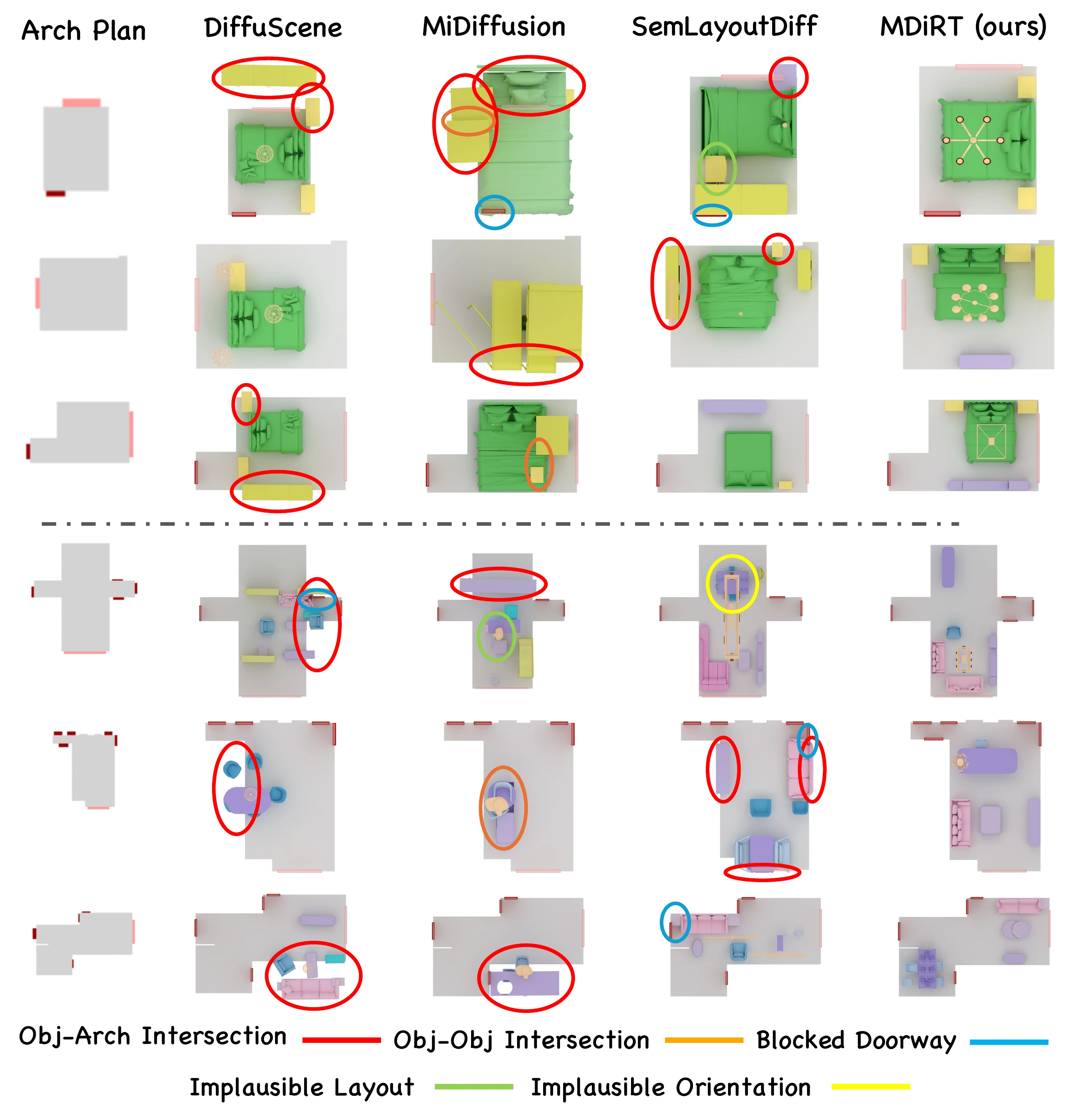
Given the same floor plans, MDiRT keeps furniture within room boundaries, reduces collisions, and leaves door and window openings clearer in these examples.
Top-down 3D-FRONT layouts for the same architectural plans from DiffuScene, MiDiffusion, SemLayoutDiff, and MDiRT.

Acknowledgements

This work was funded in part by a CIFAR AI Chair and NSERC Discovery Grants, and enabled by support from the Digital Research Alliance of Canada and a CFI/BCKDF JELF.

We thank Jiayi Liu and Yiming Zhang for constructive feedback and discussion.